Progressive Nonprofits Slam Court’s Voting Rights Decision, Brace for Map Fights
The ruling on the Louisiana map fuels a debate over race in redistricting ahead of 2026 midterms.

By Stephanie Beasley
Senior Writer
April 30, 2026 | Read Time: 4 minutes
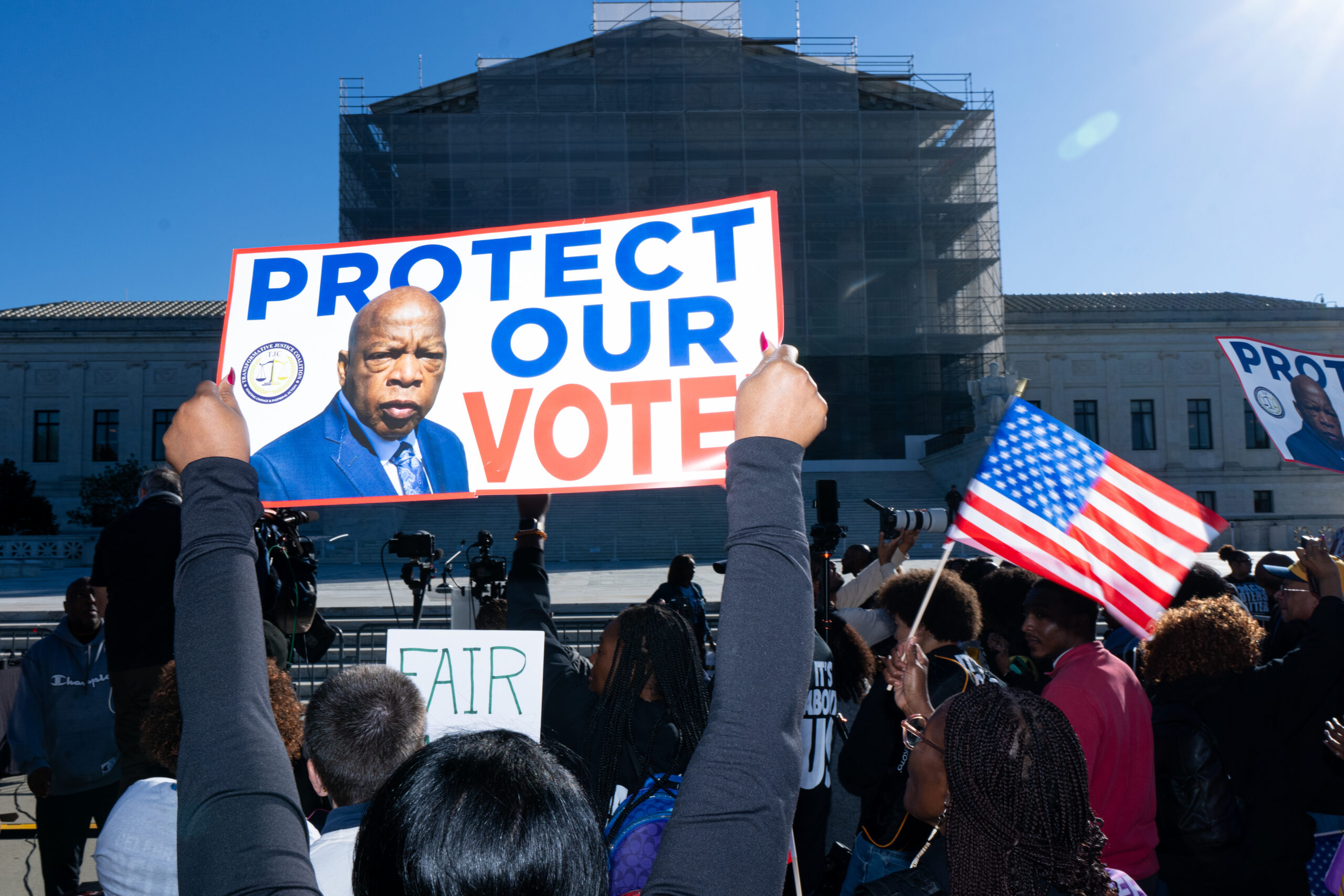
A wide range of progressive nonprofits condemned Wednesday’s Supreme Court decision to narrow a key provision of the Voting Rights Act that allowed states to consider race when drawing congressional maps. They argue that the decision will allow states to draw voter maps that eliminate districts designed to allow racial minorities to elect representatives of their choice and will therefore discriminate against them.
At the same time some conservative think tanks hailed the ruling as a win for equal voting protections and a rebuke of race-based redistricting.
In the case, Louisiana v. Callais, the Supreme Court’s conservative majority struck down the state’s latest congressional map, which created a second Black-majority congressional district. In a 6-3 decision written by Justice Samuel Alito, the court said the Voting Rights Act does not require states to draw districts predominately on the basis of race. In his decision, Alito wrote that to run afoul of Section 2 of the act, which allows for consideration of race in redistricting, there had to be a “strong inference that intentional discrimination occurred” when mapping a district — something that critics say is very hard to prove.
The ruling is the latest in a series of Supreme Court decisions that have steadily narrowed the reach of the landmark 1965 Voting Rights Act. The decision lands as states continue to face lawsuits over lines drawn after the 2020 census and the partisan mid-decade redistricting race set off by Texas and as both parties prepare for 2026 midterm races. Voting rights groups said the ruling will embolden legislatures to pursue maps that reduce minority representation, and they renewed calls for federal legislation to restore protections.
Progressive Outcry
The Supreme Court’s ruling could embolden politicians to dilute the electoral power of historically marginalized communities, said Independent Sector CEO Akilah Watkins.
“Recent history shows that when courts water down the Voting Rights Act’s guardrails against racial discrimination, politicians feel empowered to intensify efforts to deny minority groups the opportunity to elect the candidates of their choice,” she wrote in a statement Wednesday night.
The ruling weakens Section 2 of the act “to the point of inoperability” and “opens the door to racist redistricting,” League of Women Voters president Dianna Wynn and CEO Celina Stewart wrote in a statement. The court has signaled that discrimination against Black voters and other voters of color will be tolerated “as long as you don’t say it out loud,” they wrote.
The decision “dismantled the ability of voters of color to have a fair chance for representation” and “encouraged partisan gerrymandering,” wrote Michael Waldman, CEO of the Brennan Center for Justice at New York University School of Law. Congress must respond by banning gerrymandering in congressional races, renewing voting protections, and considering Supreme Court reforms such as term limits, he wrote.
The ruling “all but ended” the act’s promise that communities of color can seek fair congressional districts, wrote Common Cause, a government watchdog group. The organization urged Congress to pass new voting rights legislation and said it would focus on efforts including state-level voting rights acts, challenging federal actions in court, and fighting what it described as “mid-decade gerrymanders” ahead of the 2026 election.
The ruling would allow states to “enact discriminatory maps with impunity,” the NAACP Legal Defense and Educational Fund warned. The court “reversed decades of progress toward a multiracial democracy,” said president and director-counsel Janai Nelson, who called it “a day of shame for the Supreme Court.”
The ruling “seriously undermined” the ability of Black, Latino, and other minority communities to achieve equal voting rights, according to the Mexican American Legal Defense and Educational Fund, or MALDEF. The decision “dismantles the legal protections for minority voters as we become a more important voice in the country’s politics,” wrote Nina Perales, MALDEF’s vice president of litigation.
The decision is “a profound betrayal” that weakens the primary tool voters of color use to challenge discriminatory maps and election systems, wrote the American Civil Liberties Union voting rights project director Sophia Lin Lakin. In practical terms, she said, communities could be left without “the most significant weapon” to stop states from drawing districts that dilute minority political power.
The ruling is the latest step in what the American Constitution Society described as Chief Justice John Roberts’s court’s effort “to hollow out the Voting Rights Act … until nothing meaningful remains.” The group said the effects will be “devastating,” not only for congressional maps but also for local government districts, noting that many Section 2 cases challenge city and county election systems.
Conservative Approval
Conservative groups praised the ruling as a constitutional correction. Alito’s opinion confirmed that lower courts had misread the Voting Rights Act by pressuring states to take the “wrong” approach and sort voters by race, according to the Heritage Foundation. The decision makes clear that Section 2 was meant “to enforce the Constitution — not collide with it,” wrote Zack Smith, a senior legal fellow at Heritage. He predicted some states will have to revisit maps drawn under what he called misguided interpretations. The court prevented the Voting Rights Act from becoming “a tool for partisan gerrymandering” wrote America First Policy Institute chair for election integrity Kenneth Blackwell. He added that the decision reinforced the principle that the government “cannot divide citizens based on race.”