Can AI Make Grant Seeking Easier and Grant Making More Refined?
Some experts think AI could upend the entire process, resulting in a more automated system to bring nonprofits and foundations together.

By Alex Daniels
Senior Editor, Foundations

April 7, 2026 | Read Time: 8 minutes
The GitLab Foundation, the $30 million philanthropy of the AI software company with the same name, needed some extra brains to sort through all of the funding requests it received in September. It was offering a total of $4 million in grants to nonprofits testing ways to better use artificial intelligence to improve economic opportunity. So naturally the grant maker turned to its own AI systems to make sense of the 800 applications that flooded in.

Reviewing such a big stash of applications would take GitLab’s three program officers hundreds of hours without the aid of technology, said Ellie Bertani, GitLab Foundation’s president. With an “aggressive” use of AI to screen the applications, the whole thing took 30 minutes.
Bertaini’s team trained its AI tool to look at several criteria, including what kind of wage gains the applicants could produce, how strong their partnerships are, and what kind of data-security systems they have in place.
Using AI to query large data sets allows Bertani to more easily observe trends in applications, including where resources may be most needed and how the foundation can fine-tune the questions it asks of grantees.
GitLab Foundation’s enthusiasm for AI makes it a bit of an outlier among grant makers. While many other foundations use the technology for aspects of their grant-selection process, only a small subset use the tools in an all-encompassing way, according to Chantal Forster, specialist in the use of technology in philanthropy who has consulted with more than a dozen foundations on AI use, including the Annenberg, Lumina, MacArthur, and Robert Wood Johnson foundations.
Philanthropy technology experts like Forster envision foundations and nonprofits using AI to make applying for a grant faster. It could also help match grant seekers and grant makers with shared purposes and strong approaches to problem solving. A more radical use of AI and its ability to make sense of huge data sets could upend the entire grant-application process, resulting in a more automated system to bring nonprofits and foundations together.
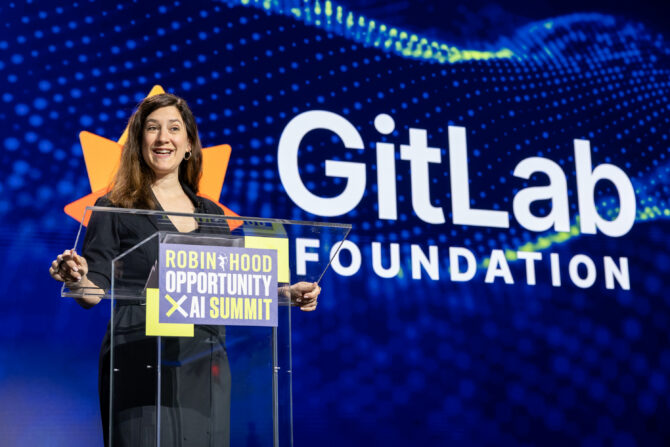
At the GitLab Foundation, Bertani and her staff have fed troves of data from grant applications, grant reports, and check-in calls to a large language model that can respond to prompts, help identify patterns, and provide insights into things like common factors for success and failures among the 190 grants the foundation has made.
“It helps us define our strategy going forward,” she said, before adding that the responsibility for making actual grant decisions still rests with people, rather than a machine.
Ultimately, the use of AI can help GitLab with its main job: getting money to nonprofits quickly, said Bertani.
“We feel an acute responsibility to get the funds out the door as quickly as possible because we don’t actually create impact; the grantees do,” she said. “AI can be really helpful in speeding up the process of insight gathering, making good bets, and getting the money out the door.”
AI Ambivalence
Foundation staff are using AI — Forster says that about 60 percent are trying out free tools like ChatGPT — but most grant makers don’t have a formal plan for how to use it. The upshot, Forster said, is that grant makers don’t have a handle on how AI is influencing their work and how it could best be used.
In many cases, foundation staff are leery about the use of AI because it may end up putting them out of jobs.
In many cases, foundation staff are leery about the use of AI because it may end up putting them out of jobs, she says. As more philanthropies face pressure to push more money out the door to grantees, program staffers represent overhead costs that can be reduced with the use of technology tools.
Cash-starved nonprofits, she said, face a different dynamic when considering AI.
“They have real financial constraints,” she said. “They want to use whatever tool they can use to get the job done” and reduce costs.
When the Center for Effective Philanthropy surveyed nonprofits and foundations last spring, it found that grant makers did not have a clear view into how grantees could benefit from AI. More than 80 percent of foundations surveyed said their staff had little or no understanding of how AI could help grantees become more effective and had little idea of the technical capacity of grantees to use AI.
Despite the uncertainty about how AI could help the grant-seeking process, the rapid growth of automated tools has put enormous pressure on nonprofits to incorporate them into their plans. Before doing so, suggests Jean Westrick, president of the Technology Association of Grantmakers, leaders should thoughtfully craft a plan.
The use of technology won’t reduce funding inequities unless people remain deeply involved, she said. And using it just to speed up decision making can lead to unintended consequences. Only human engagement can help ensure underrepresented organizations are discovered and supported, she said. What she’d like to see is an application process that looks more like a dialogue between funder and grantee.
“The application process is broken, and AI is not going to solve it,” she said.
AI Can Cause You to Overcommit
Last fall the Habitat for Humanity of Michigan held an AI training session for the 43 Habitat offices across the state. Wendy Clow, the group’s director of operations, who led the sessions, was concerned about how or even whether the groups, which vary in size from two staffers to 70, were using the technology.
She wanted to get everyone on the same page, and so she and a consultant provided training on AI policy, how to use AI to draft fundraising emails, and how to automate tasks like acknowledging donors, among other topics.
Clow is evangelizing the use of AI in applying for grants because it’s helped her personally. Using Google NotebookLM, Clow can take a 20-page request for proposal from a foundation that is overflowing with “legalese” and get a synopsis that’s easy to digest. Using the tool, she can quickly decipher what other resources she might need to accompany her application, including data on her operations, staff time from members of different departments, or letters of support from financial institutions or partners.
Clow can’t provide a definitive return on investment figure for her increased use of AI in applying for grants. But she said that artificial intelligence saves her time and drafts language in her proposals so they more closely hew to the funding organizations’ mission and priorities.
It’s really easy for AI to help you look bigger than you are. If you let AI write a narrative for you, it can add a lot of fluff, and that can be dangerous.
— Wendy Clow, director of operations at Habitat for Humanity of Michigan
But, she said, she would never use AI to craft a proposal and then just ship it off. Without a set of eyes looking over anything that a tool has used, it’s possible the artificial intelligence will be a little too exuberant about the capabilities of a nonprofit.
“It’s really easy for AI to help you look bigger than you are,” she said. “If you let AI write a narrative for you, it can add a lot of fluff, and that can be dangerous. It can cause you to overcommit.”
A Human Touch
Grant makers can tell, too, if an application has been conjured from AI.
When grant writers use AI to quickly churn out an application, it often isn’t “up to snuff,” said Allison Bajracharya, chief impact and strategy officer at the Ewing and Marion Kauffman Foundation.
“When we see something that feels very generic, or if it doesn’t really speak to the questions we’ve asked, that raises some red flags for sure,” she said.
Last fall, Kauffman rolled out an enterprise-wide AI system to help with its research and to enhance the grant-review process. Bajracharya said the adoption of AI has been piecemeal throughout the organization, but with the addition of an AI fellow this spring, she thinks the grant maker will adopt a more fully developed plan.
Bajracharya’s first concern was security. She didn’t want applicants’ proprietary information or foundation data to be sucked up into the massive data banks that make AI possible. With an enterprise system, all of that information is secure within the organization.
She also didn’t want AI to replace the discernment of her staff experts. While AI helps Kauffman staff suss out different insights about applications, program officers still do a first pass on the 100 or so grant applications the foundation receives each grant cycle.
One way AI can help is to compare sets of similar applications. Bajracharya and her staff can query a batch of, say, 10 applications, using AI to develop side-by-side comparisons on a number of factors, including impact, and highest expenditures and other budget items.
Using that matrix can be helpful in giving Bajracharya a gut check about whether an applicant’s plans are feasible or too ambitious. But ultimately she and her staff have the final say.
Says Bajracharya: “We don’t want to just substitute for judgment.”