This Nonprofit Whispers in Hollywood’s Ear About Polarization. They Hope You Tune In.
Bridge Entertainment Labs aims to be the entertainment consultancy for the bridge-building field.

By Eden Stiffman
Senior Editor
April 23, 2026 | Read Time: 13 minutes
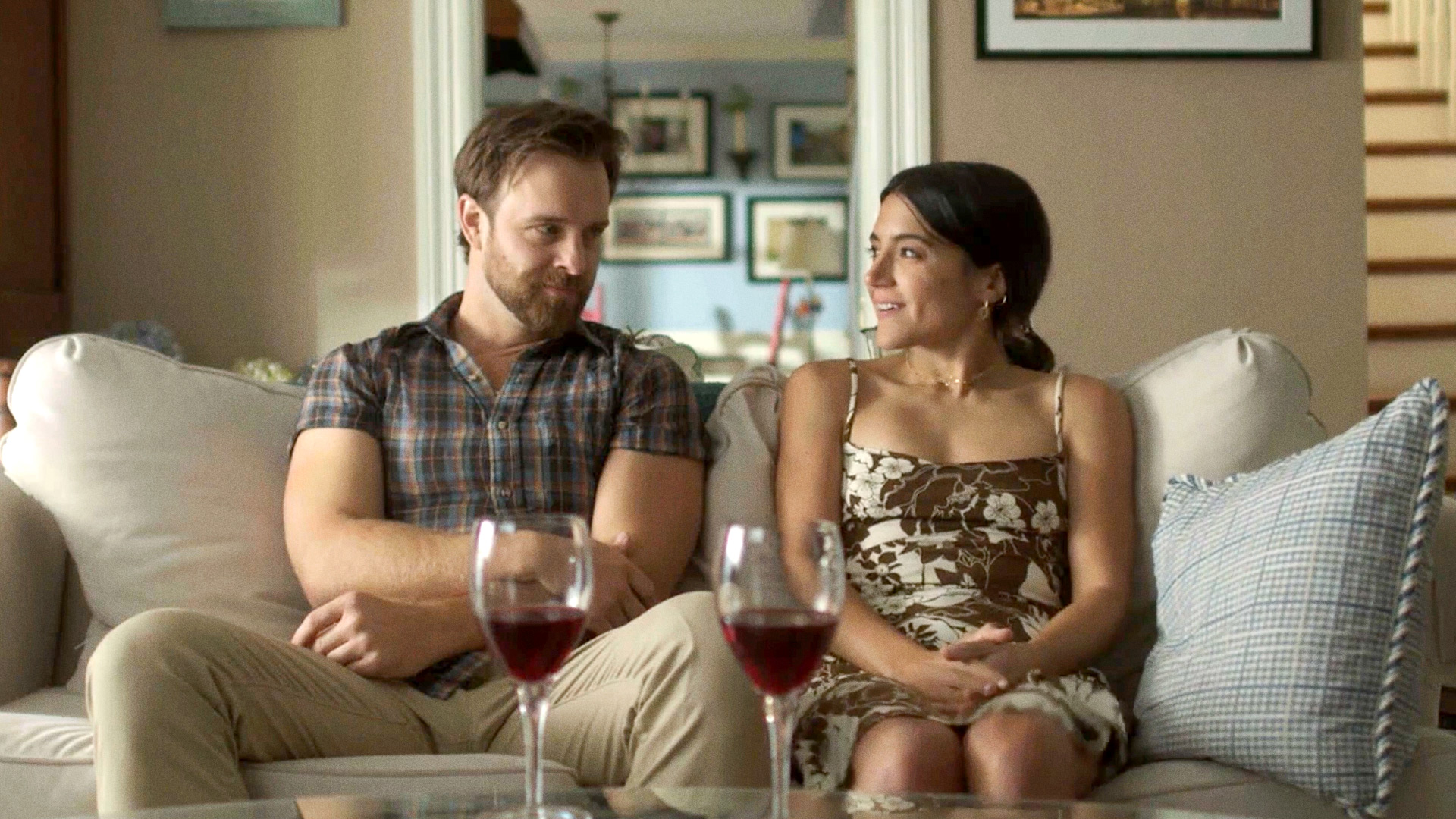
When Erik Bork wrote The Elephant in the Room, he wasn’t trying to make a political statement.
The 2025 romantic comedy centers on a pandemic-era romance about a new couple who seem well matched. They share easy banter and chemistry but soon discover they voted for different candidates. She’s a proud progressive. He voted for Trump.
Suddenly, ordinary conversations feel loaded. The budding relationship doesn’t end, but it changes, as each character begins to see the other as someone shaped by a different set of assumptions, loyalties, and fears.
“I never felt that it was supposed to preach or send a message or be some kind of social change agent,” says Bork, an Emmy Award-winning writer and producer with credits on projects like the HBO series Band of Brothers. He wanted to tell a story that felt real — “sweet, funny, edgy,” as he put it — about something many Americans are navigating in their own lives.
As Bork worked to get the film financed and shot, he found himself pulled into a broader experiment — and into the orbit of a nonprofit trying to influence Hollywood from the inside: Bridge Entertainment Labs, along with one of its seed funders, the Civic Health Project.
Bridge Entertainment Labs works as a kind of consultancy to the entertainment industry: advising writers, producers, and executives on how to integrate themes of pluralism and shared humanity into their work. Rather than trying to reach audiences directly, the goal is to “influence the influencers” who shape what millions of people watch.
The instinct behind Bridge isn’t new. Nonprofits have long tried with mixed results to influence culture with awareness campaigns on everything from breast cancer and bicycle lanes to climate change and marriage equality. They have spent funds on advertising, worked with celebrity spokespeople, and tried to push narratives through media of all kinds. Bridge’s approach is more indirect: working upstream, with storytellers who shape what audiences see, rather than trying to reach those audiences directly. It’s a potentially effective route that groups can use as part of their broader strategy to get their messages across to an ever harder-to-reach public. Big funders — including Stand Together and the Packard and John Templeton foundations — have invested in Bridge’s approach. But this kind of work demands patience and a tolerance for ambiguity. Impact may take years to surface. If Bridge’s work is effective, funders may find that being patient and learning to accept quiet influence over visible results can yield important change.
But the openness of some funders to back this approach reflects a broader shift in how they are thinking about social change: not as something driven only by policy or programs but by culture itself. If culture shapes how people think, then subtly changing culture may be one of the most powerful ways to address the challenges of our time.
Hollywood has gotten very good at giving each America the stories it wants. In an era of niche audiences and polarized tastes, making a TV show or film that half the country will hate is often the safest bet. The hard thing is making something that might help both halves see and understand each other.
“We essentially needed an entertainment arm to the bridge-building movement,” says Bridge Entertainment Labs CEO Steven Olikara. “Our fellow Americans don’t often fit into the boxes that the media creates for them. Those boxes help to fuel polarization.”
Stories don’t merely inform people, Olikara says. They shape what feels normal, what feels possible, and who feels recognizable. With Bridge Entertainment Labs, he says, the goal is to move beyond “us versus them” narratives and toward “a cohesive you-and-I story of what we can build together.”
A Bet on Stories
Bridge Entertainment Labs didn’t emerge fully formed. Civic Health Project, a funder focused on reducing toxic polarization, spent several years incubating the effort, initially called the Center for Entertainment and Civic Health. It set out to find out how it might best address polarization in a way that could be truly scalable. The answer was entertainment, says Ann Reidy, who led the incubation effort.
The project was grounded in decades of research suggesting that entertainment can influence how people think and feel.
“Entertainment stories have the power to raise awareness, shift attitudes, and potentially inform behaviors,” says Erica Lynn Rosenthal, director of research at the Norman Lear Center at the University of Southern California, which has studied the power of entertainment in shaping culture for more than 20 years.
The mechanisms behind that influence are well documented. Stories cause people to develop a feeling of connection to fictional characters. Those dynamics can make stories more persuasive than more overt forms of communication.
“Entertainment gets people to suspend disbelief,” Rosenthal says, allowing ideas to “fly under the radar” without audiences consciously recognizing they are being influenced.
Bridge Entertainment Labs has tried to translate those insights into practice, grounding its work in social science theories like “parasocial contact,” in which audiences form relationships with characters unlike themselves, and “vicarious contact,” in which viewers observe positive interactions between members of different groups.
While the group is forging ahead with its work, the underlying science remains less certain. Much of the strongest evidence for entertainment’s power to build connection across difference comes from studies focused on reducing prejudice toward social groups — based on race, sexuality, or religion, for example — or influencing specific health behaviors, not from attempts to reduce partisan division.
Applying those insights to political polarization is less straightforward. Unlike climate or public health campaigns — whose goal is often to shift attitudes in one direction — efforts to address political polarization must reach audiences across ideological lines at once, a far more complicated task and one still being researched.
Bridge has used a measurement tool called the Social Cohesion Impact Measurement (funded and created by the Civic Health Project) to measure the impact of a few specific pieces of content — such as episodes of black-ish and The Conners — on viewers.
“There’s so many interesting questions out there that remain unanswered,” Reidy says. The Civic Health Project continues to provide some financial and in-kind support to Bridge. The group has raised some $2.2 million since its inception.
Getting Inside Hollywood
When Bridge spun off into an independent effort in 2023 (it remains a fiscally sponsored project), Olikara — a jazz musician and former political candidate and organizer who built the cross-partisan group Future Caucus — joined as founding CEO. He had his work cut out for him, essentially building a network of relationships in the entertainment industry from scratch.

With a core team of seven staff, including interns, it leans heavily on its advisory council, which includes creatives with writing and production credits on major network sitcoms like Cheers and Buffy the Vampire Slayer, along with prominent academics and leaders in the broader bridge building field.
In a relatively short time, Bridge has gained access to major players in the entertainment industry. The group has provided consultations to studios including Disney, Paramount, and A24, offering both broad briefings for executives and project-specific feedback.
“In Hollywood, the real leverage point isn’t just the writer’s room — it’s the greenlight meeting,” says Jeffrey Abramson, Bridge Entertainment Labs’ chief program officer, referring to the meeting in which projects are given the go-ahead.
The group’s pitch to Hollywood executives isn’t purely social; it’s also economic. Bridge-building storytelling may be easier to sell when it’s framed as audience expansion rather than social mission.
Because the entertainment industry ultimately responds to audience demand and commercial pressures, Bridge has increasingly focused on making a business case alongside a social one. That has only become more important as studios have grown wary of content perceived as politically charged.
“There’s been a shift toward making the business case rather than letting the social impact case speak for itself,” says USC’s Rosenthal, who has observed the trend across the field.
Research suggests that audiences are more fragmented than ever, but not always along simple partisan lines. Media consumption is increasingly shaped by “shared values” rather than demographics or ideology alone, Rosenthal says, with audiences clustering around what matters to them: family, health, or identity.
From Research to Script Notes
In its work with creatives, Bridge aims to translate research in ways that are approachable.
Creatives are often inundated with tips and guides, Reidy says. “They’re getting notes from so many different people. … The last thing they want is more guidance on how they should be telling their stories.” That reality has shaped how Bridge presents its work.
The organization developed a set of storytelling principles it calls the “4 C’s” — curiosity, contact, complexity, and “good conflict” — as a way to help creatives build narratives that humanize opposing perspectives without flattening them. In practice, curiosity might mean writing a character who genuinely wants to understand someone different from themselves; “good conflict” means dramatizing disagreement in ways that reveal rather than caricature.
Its influence is often embedded in small choices: how a character is framed, what motivations are emphasized, where conflict lands.
For example, when Bork was working on The Elephant in the Room, Bridge provided support and script feedback, helping him think through how different audiences might respond.
In one draft of the script, the male lead, Vincent, planned to attend the January 6 attack at the U.S. Capitol. Bridge advisers suggested that the detail risked alienating audiences.
Bork rewrote it and introduced a grandmother character who wanted to go. Vincent weighs taking her, but after consulting with his new love interest, decides not to.
The change made the character more accessible across audiences, Bork says.
“It softens the extent to which he does things that liberals would think of as hardcore, like go to the rally himself,” he says. “It ended up being a good choice.” Bridge Entertainment Labs is named as an executive producer on the film.
Not all of Bridge Entertainment Labs’ work involves shaping scripts. The group also works to influence how stories are positioned, distributed, and discussed.
For the documentary series Bucks County, USA, which follows a politically divided Pennsylvania community navigating local conflicts in the school system and beyond, the organization became involved later, helping elevate the project at Sundance with a screening and panel discussion with filmmakers and producers.
Implicit Storytelling
Projects like The Elephant in the Room have given the group an opportunity to engage audiences explicitly with polarization. But such clear-cut stories are not the group’s primary focus.
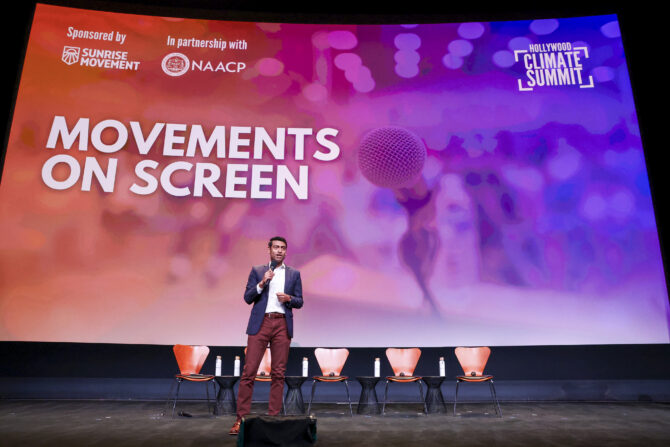
Much of its work focuses on what it calls “implicit” storytelling: embedding ideas about pluralism and shared humanity into character and narrative without making them the main subject. A story about a family business might include a character who defies partisan type. A crime drama might portray a rural community with more complexity than cable news tends to allow.
“If it feels like a lesson, it doesn’t work,” Olikara says.
That approach aligns with what researchers say about how audiences respond to persuasion.
“When people feel like they’re being preached to or manipulated … they tend to shut down and reject the message,” Rosenthal says. The challenge, she added, is finding “a really delicate balance” — embedding ideas in ways that feel authentic rather than didactic.
“People are not likely to change deeply held beliefs after watching one show or film,” Rosenthal says. “But they might start to see something differently. They might talk about it. They might become a little more open.”
A Changing Industry?
For Olikara, the mission goes beyond the individual projects. It’s about building a community of storytellers who see this kind of work as part of their craft, something that, a few years ago, barely existed.
Leaders say they are beginning to see shifts.
When Bridge first showed up at Sundance, the idea of bridge-building storytelling was “on the periphery and even controversial,” Olikara says. At the latest festival, where the organization hosted several panels and events, conversations about polarization and shared identity were more prominent.
“We just see more and more of an effort among storytellers to connect our mission to the work that they’re doing,” Olikara says. “It’s now really part of the zeitgeist in the industry.”
Abramson described a similar change, from skepticism to curiosity.
At Sundance, which he has attended for more than 30 years, “the collective illusion within the community was that everybody had to be on the same ideological agenda.” But since Bridge showed up, he’s been struck by how many conversations are now happening — both on stage and privately — that touch on these themes.
“So many people actually did care tremendously about finding common ground or giving people a little bit more space and canceling cancel culture,” he says. “We’ve helped create the permission structure that it’s actually okay to have this conversation about recognizing when you’re in a bubble or speaking more your own personal truth.”
While there’s a perception of Hollywood being an overwhelmingly progressive industry, Bridge intentionally works with storytellers and studios that come to their work from a range of perspectives.
Companies like Angel Studios, whose projects often have a faith-based component, have built large audiences by appealing to viewers who often feel underserved by mainstream Hollywood. An Angel Studios executive recently appeared on a Bridge panel at Sundance about creating stories that unite.
“We do work with a lot of conservative or right-of-center storytellers who often feel ostracized in the industry, who often feel like they can’t be themselves in a writers’ room,” Olikara says.
“There are many more people in the entertainment industry, storytellers we work with who are more heterodox in their views, beliefs, and political opinions, than people would realize,” Olikara he adds. “They almost come out quietly to us. They feel like we are a trusted space where they can truly be their full selves and not have to silence certain parts of them for fear of being canceled.”
Another indication that Bridge is making inroads: Last month, in the week leading up to the Oscars, Olikara was honored with a Common Ground Award at the Lumen Awards, which recognizes both filmmakers and advocates whose work uses entertainment to address urgent issues.
All of this hard work building relationships often shows up in small ways. A line of dialogue that lands differently. A character who feels a little harder to dismiss. A moment of conflict that doesn’t end in contempt.
“Stories that help people feel seen make them one of the most powerful tools we have to combat the toxic polarization we have in our country today,” Olikara said in his acceptance speech at the Lumen Awards, looking out into an audience of Hollywood creatives. “This is the room that I think is more powerful than any other I’ve been in to make common ground a reality in America.”
The Commons is financed in part with philanthropic support from the Arthur M. Blank Family Foundation, Einhorn Collaborative, and the Walton Family Foundation. None of our supporters have any control over or input into story selection, reporting, or editing, and they do not review articles before publication. See more about the Chronicle, the grants, how our foundation-supported journalism works, and our gift-acceptance policy.